

What Possibilities Does Automation Offer in Soldering?
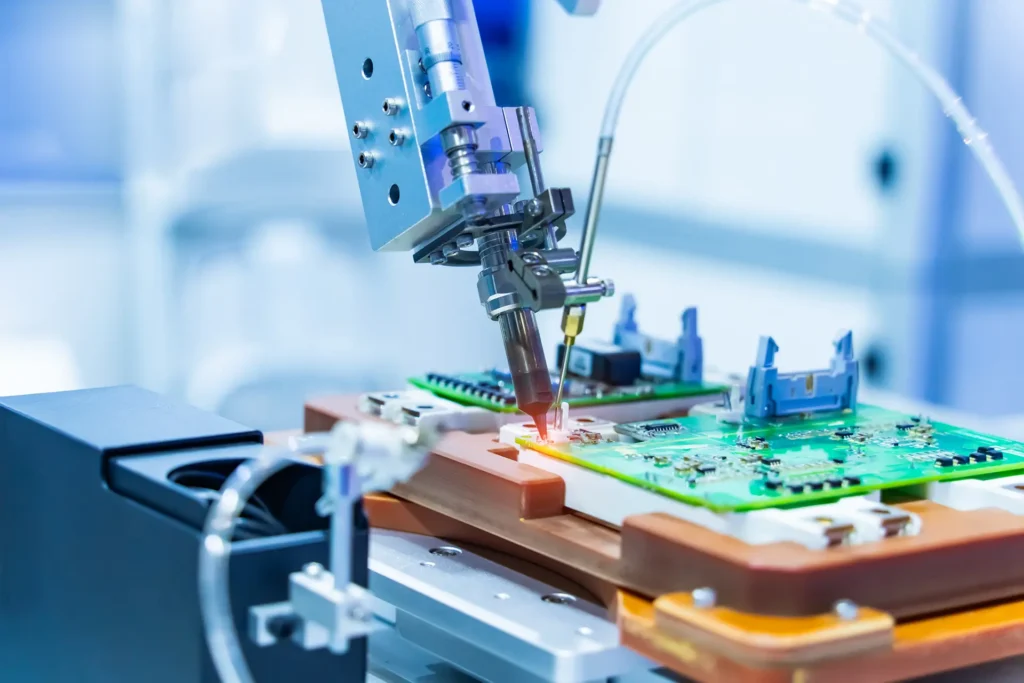
Automation in soldering encompasses a variety of technologies and functions. These range from the automatic storage and control of individual process parameters to fully automated soldering systems and robotic systems.
Some of the most important options include:
- temperature control and temperature storage
- saving defined soldering profiles
- robotic soldering technology
- In-line Soldering Machines
- smart soldering stations
Depending on the application, these technologies can be used to support individual steps or to automate entire soldering processes.
Temperature Control in Automated Soldering Processes
Precise temperature control is a key factor in automated soldering processes. Automated soldering stations can be equipped with temperature storage systems that ensure defined temperatures are reliably maintained.
This supports consistent solder joint quality and helps prevent damage to sensitive electronic components.
Controlled temperature is particularly important when working with different materials and under different soldering conditions. Different melting points and thermal conductivities each require process parameters that are tailored to them.
By storing and precisely controlling the temperature, automated systems can respond accordingly. This allows materials to be soldered with precision, without causing overheating or cold solder joints.
Controlled temperature regulation therefore helps to:
- improve the reliability of solder joints,
- help ensure consistent soldering quality,
- reduce material wear and
- avoid unnecessary energy consumption.
Automated Soldering Stations
Learn more about the various accessory options for automated soldering stations.
Soldering Profile Storage in Modern Soldering Stations
In addition to temperature control, the storage of soldering profiles plays an important role. A soldering profile describes the temperature curve over time during the soldering process. This includes, among other things, the heating, dwell, and cooling phases.
Automated soldering stations and soldering systems can store defined soldering profiles and execute them repeatedly. This allows soldering processes to be carried out under consistent conditions. This is particularly important in the production of large quantities and complex assemblies, where consistency and precision are crucial.
Appropriate soldering profiles can be defined for different assemblies and materials. This ensures that the required parameters are reliably applied. This can help to,
- improve the quality of solder joints,
- make processes more reproducible,
- reduce error rates and
- avoid rework.
Another advantage is greater flexibility. When new materials or assembly designs are incorporated into the production process, corresponding soldering profiles can be created and integrated into the system. This allows automated soldering processes to be adapted relatively quickly to changing production requirements.
Additional Options for Automated Soldering
In addition to temperature and soldering profile storage, other technologies are available for automation in the soldering process.
Specially programmed industrial robots can be used for automated soldering. They enable complex and precise soldering processes and are particularly well-suited for applications that require high repeatability and speed.
Inline soldering machines are designed for integration into automated production lines. They support continuous production processes and enable high throughput rates.
This makes them particularly well-suited for applications involving large production volumes.
Smart soldering stations use sensors and digital technologies to collect and analyze process data.
The data collected can be used, for example, to optimize soldering processes or to identify maintenance needs early on. This allows for further improvements in the efficiency of the soldering process.
What Are the Advantages of Automated Soldering Processes?
Automation in the soldering process offers advantages primarily in terms of efficiency, productivity, and reproducibility.
Automatic soldering stations and robotic systems can perform processes continuously. This makes it possible to produce larger quantities in less time and reduce lead times.
Consistent Quality and High Precision
Manual soldering processes can be subject to variations. Automated systems, on the other hand, repeatedly perform defined movements and process parameters under comparable conditions. This helps ensure consistent quality in solder joints. Semi-automated functions, such as stored soldering profiles, also reduce potential deviations and contribute to reproducible results.
Flexibility with Changing Production Requirements
Modern automated soldering systems can often be programmed for different product types and sizes. This allows production processes to be adapted to new requirements and setup times to be reduced. This flexibility offers a significant advantage, particularly in electronics manufacturing, where products and production requirements can change rapidly.
Fewer Errors, Less Scrap, and Less Rework
The initial investment costs for automated soldering systems can be high. In the long term, however, total costs can be reduced through lower labor requirements, fewer defects and less rework, as well as optimized material utilization. Automation can be particularly cost-effective for repetitive soldering tasks and larger production volumes.
Improved Working Conditions
Automation can also help relieve employees of physically demanding tasks. Soldering can involve high temperatures and fumes. If the relevant process steps are automated, employees can focus more on tasks such as monitoring and quality control. In this way, automation can also help improve working conditions.
Automation in Soldering with Electronic Metals
Automation in the soldering sector offers a wide range of opportunities to make production processes more efficient, more reproducible, and more flexible.
From stored temperatures and soldering profiles to smart soldering stations and robotic soldering technology, a variety of technologies are available. Manufacturers can use these to tailor their soldering processes to the specific requirements of their electronics manufacturing.
Electronic Metals Offers Soldering Stations and Other Tools for Electronics Manufacturing
Check out the available solutions in our online store, or get advice on the right products for you.
